
Why training outside gets better results
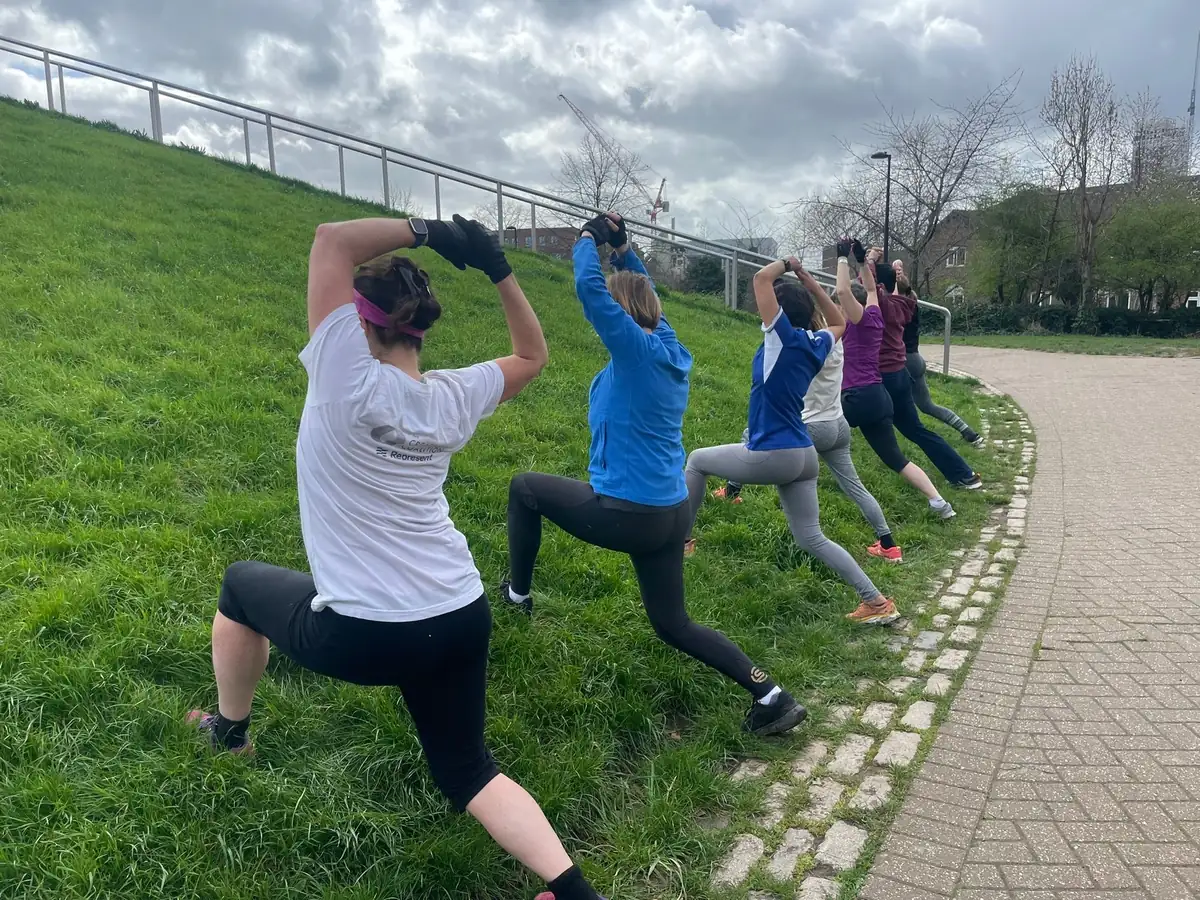
Training outside gets better results because your body has to do more of the work itself. Grass, hills and uneven ground ask you to stabilise, react and balance in a way that a fixed machine never does.
Most of us in SE16 spend our days indoors and sitting down. Desk, sofa, train, repeat. Over years that quietly teaches your body to move in a narrower and narrower range, and then we try to fix it with a machine that holds us in one plane and moves us back and forth for half an hour. Gym machines have their uses, but they take away the exact job your body most needs to relearn.
Uneven ground makes your body work properly again
At Stave Hill Ecological Park the terrain does half the coaching for us. There are steps to climb, a hill to run, soft grass, tree roots and paths that camber. Every step you take on ground like that sends information up through your feet, ankles and hips, and your body responds by stabilising. Do that twice a week for a few months and balance, ankle strength and coordination improve on their own.
The same applies to the lifting. Picking a kettlebell up off grass, carrying it, putting it down and picking it up again is a whole movement pattern. It is also exactly what you do when you carry shopping up the stairs at Canada Water station or lift a suitcase into a boot.
Every session is coached, so nothing is guesswork
Outdoor training only produces results if someone is watching how you move. That is the part people miss when they picture a bootcamp as a stranger shouting at a field full of people.
In our sessions the coach sets the work, demonstrates it, then walks the group and adjusts. If your knees cave on a squat, you get told. If your back is rounding on a deadlift, you get a lighter weight and a cue. If your shoulder has been sore since Tuesday, you get a different exercise for that station. You get the individual attention of personal training with the momentum of a group around you, which is a combination most people find much easier to stick to than training alone.
What this actually changes in everyday life
- Stairs stop being an event. You get to the top of the escalator at Canada Water without arriving out of breath.
- Carrying things gets easier, because you have practised lifting from the floor rather than from a rack at hip height.
- Your joints feel better supported, because the muscles around them have been asked to do their job.
- You trip less and recover better when you do, which matters a great deal more the older you get.
These are unglamorous outcomes. They are also the ones members tell us about after six months, far more often than they mention a number on a scale.
The part nobody puts in the brochure
Outdoor training is easier to keep doing. You are in daylight and fresh air, the view changes with the seasons, and the session is over before your motivation gets a chance to argue with you. Consistency beats intensity every time, and the training you actually keep doing is the training that works.
You do not need to be fit to start, and you do not need to know any of the exercises. Book a quick call with us first. At your first session, tell the coach it is your first time, and let the ground and the group do the rest.